
Janesville Epoxy Flooring provides concrete grinding and surface preparation in Janesville, WI, serving surrounding cities including Milton, Edgerton, Beloit, South Beloit and Evansville. Grinding is the step every one of our floors depends on, and after more than 20 years we still consider it the most important hour of any coating job. A coating can only bond to the concrete it actually touches, and grinding is what decides what that is.
We grind slabs ahead of our own epoxy, polyaspartic, metallic and polished systems, and we also prepare floors for other trades and for flooring that is not a coating at all. Removing old coatings, sealers and adhesives, flattening high spots and opening the surface to the right profile are all part of the work. We never acid etch.
Our proposals state the preparation method and the target surface profile, so you know exactly how the slab will be readied. We read cracks, joints and old coatings before quoting, and tell you when a slab needs repair or replacement before it can be finished. The sections below explain what grinding does and how we do it cleanly.
What Concrete Grinding Accomplishes
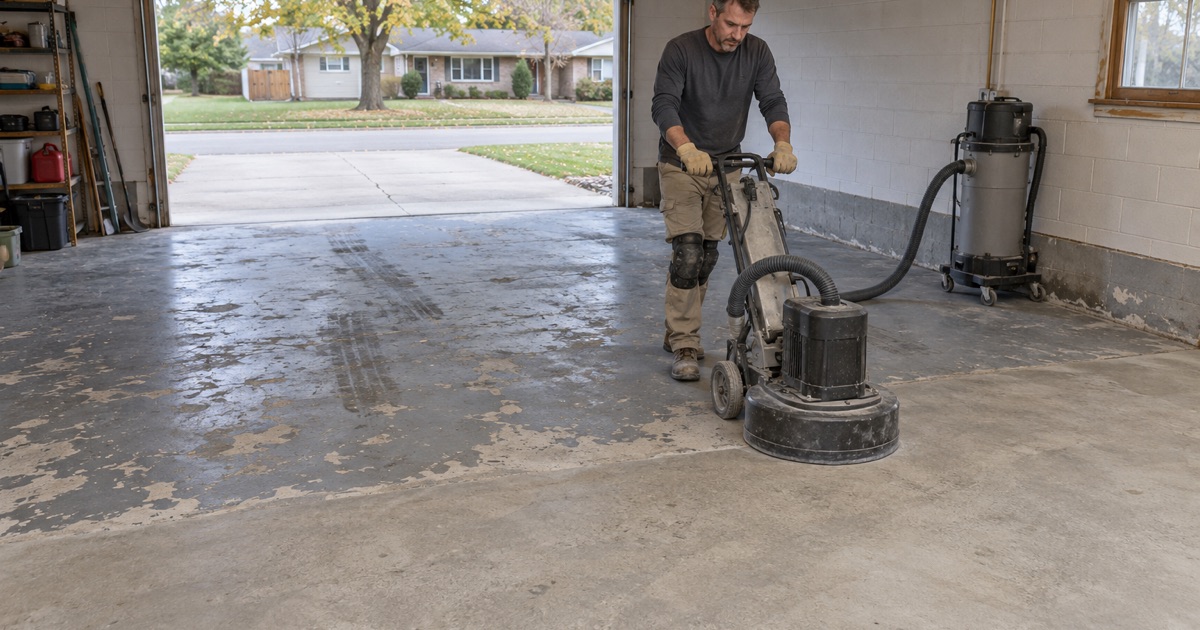
Removing Coatings, Sealers and Adhesives
Old paint, failed coatings, penetrating and film-forming sealers, carpet glue, black mastic and thin-set residue all stand between a new floor and the concrete. Grinding removes them down to clean, sound material. Leaving any of them behind gives the next layer a weak foundation that can fail in patches.
Some older black mastics can contain asbestos. When we see adhesive that may date from that era, we recommend testing before it is disturbed, so the removal is handled correctly.
Opening the Slab to a Measured Profile
The International Concrete Repair Institute describes surface texture on a scale from CSP 1 to CSP 10, from nearly smooth to very rough. Thin coatings need a light profile, while thick mortar-based systems need a heavier one. We prepare to the profile the coating manufacturer specifies and check it with reference chips.
The right profile also removes laitance, the weak, powdery layer that forms on top of fresh concrete. Bonding a coating to laitance is like gluing to dust.
Flattening High Spots and Uneven Joints
Slabs often have trowel ridges, high spots, curled joints and lips where sections meet. Grinding takes those down so the finished floor is flatter, which matters a great deal under metallic and clear coatings that reflect light. It also helps flooring installers who need a flat substrate.
Where a floor has low spots rather than high ones, we discuss filling them with a self-leveling material or skim coat after grinding. Grinding alone cannot raise a low area.
Grinding, Shot Blasting and Acid Etching
Diamond Grinding
Diamond grinding uses rotating heads fitted with metal-bond diamond segments to cut the surface. It is precise, works right up to walls with edge grinders, and handles coatings and adhesives well. For polished concrete, the same machines continue through finer diamonds to refine the surface.
We choose diamond types to suit the hardness of the slab and what we are removing. Soft and hard concrete cut very differently, and the wrong segment can smear or glaze the surface instead of opening it.
Shot Blasting
Shot blasting throws steel shot at the slab and vacuums it back up, leaving a uniform, textured profile. It is efficient on large open floors and ideal where a heavier profile is needed for thick systems. It is less suited to tight spaces, which is why we often pair it with edge grinding.
Because it leaves more texture than light grinding, shot blasting is matched to the coating that follows. We do not use it where a thin finish would show the pattern.
Why We Never Acid Etch
Acid etching reacts only with exposed cement paste, so it cannot remove sealers, paint or adhesives. It leaves an inconsistent profile that is hard to measure, and leftover residue or moisture from rinsing can weaken the bond. It is the method most do-it-yourself coating kits rely on, and one reason those coatings peel.
Mechanical preparation gives a clean, measurable surface every time. That consistency is what allows a manufacturer’s warranty to mean something.
Clean, Controlled Grinding
Dust Collection
Concrete grinding throws off fine silica dust, so every grinder we run is connected to a dust collector that captures it at the cutting head. Indoors, we isolate work areas with plastic where needed and keep the rest of the building clean. Operators wear appropriate respiratory protection.
That control matters in occupied homes, offices and plants. It also keeps dust from settling into fresh coating later in the job.
Slurry and Debris Handling
When wet grinding is used, it creates a cement slurry that must be contained. We collect slurry and debris on site and dispose of it properly, never washing it toward a floor drain, a street drain or the Rock River. Removed coatings and adhesives are bagged and hauled away.
Our crews leave the floor vacuumed and ready for the next step. A clean slab is part of good preparation, not an afterthought.
Grinding for Homes and Commercial Floors
Garages, Basements and Remodels
In homes, we grind garage and basement floors before coating, remove old paint and sealers, and prepare slabs during remodels when carpet or tile comes up. Many local houses date from the 1960s and 1970s, and their floors often carry several layers of old finish. Grinding gets back to clean concrete.
We pair residential grinding with moisture testing where a coating or new flooring will follow. Every Wisconsin home job gets a written contract before any deposit is taken.
Commercial Floor Preparation
Commercial projects often need large areas of mastic or failed coating removed quickly, and we schedule that work around operating hours, including overnight and weekends. We prepare floors for our own coatings and for other flooring trades, and can provide moisture readings against ASTM F710 thresholds for resilient flooring installers.
Joints can be cleaned out and filled with a semirigid filler after grinding where forklifts and carts will cross them. That gives the next floor a sound, supported base.
- 20+ Years in Concrete Coatings
- Moisture Testing in Every Scope
- Free Written Estimates